










By Matt Baker We’re big fans of functional programming at Wealthfront. Emphasizing immutability and functional style means fewer “surprises” because side-effects are limited or nonexistent. We can quickly build up large systems from discrete, focused components by way of composition. Applying functional programming principles is straight forward in most languages, even if they’re not functional by […]
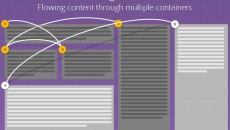
Responsive Content Using CSS Regions
By Alan Greenblatt CSS Regions allow content to flow across multiple areas of the display, called regions. The beauty of CSS Regions is that you can separate the content from the layout. And with that comes the ability to create some responsive content very easily. flow-into and flow-from The flow-into CSS property can be used to prevent […]

Two Useful Sass Features and Their Limitations
By Krasimir Tsonev I really like Sass and I use it a lot in my daily job. There are tons of useful features. However there are some things which I want to do, but can’t. There are limitations in the syntax and missing functionality. In this article I am going to share some of the ones I […]

Introduction to Animating in HTML
By Krasimir Tsonev Over the last few years, designers have begun to use a lot of animations directly within HTML. That’s kind of cool, as you don’t need a plugin in order to see their work. There are several ways to make animations in HTML and in this article I will summarize a lot of examples […]

Writing Better CSS
By Mathew Carella Writing good CSS code can speed up page rendering. Essentially, the fewer rules the engine has to evaluate the better. MDN groups CSS selectors in four primary categories, and these actually follow the order of how efficient they are: ID Rules Class Rules Tag Rules Universal Rules The efficiency is generally quote from […]

Animating with AngularJS
By Holly Schinsky AngularJS recently came out with support for CSS3 transitions and animations, as well as JavaScript Animations. The support is part of version 1.1.4 (unstable build), but was changed and refined a bit in version 1.1.5 so you should start with that version when you check it out. I definitely think it’s worth […]

Introduction to Topcoat
By Chris Griffith Topcoat is a brand new open source component library built entirely on web standards (CSS and HTML) and is available at topcoat.io. It was designed to assist developers and designers in creating high-performance web and PhoneGap applications. This project was announced shortly before the 2013 Adobe MAX conference and, in fact, the […]

Using CSS Fallback Properties for Better Cross-browser Compatibility
By Afshin Mehrabani As you may know, Internet Explorer has supported something called conditional comments which allow you to include specific HTML or CSS based upon the result of a condition. Conditional comments in HTML first appeared in Microsoft’s Internet Explorer 5 browser but it’s been deprecated as of Internet Explorer 10. Internet Explorer has several problems with CSS, specially in […]

Solving the Problem of @font-face Inside Media Queries
By Aurelio De Rosa UPDATE: With certain constraints, a better approach than the one discussed in this article exists. Read the section at the end of this post for details. Mobile data connections frequently aren’t as good as desktop ones, therefore the download time of custom fonts can take up to several seconds. A good […]

CSS Spheres
By Donovan Hutchinson Recently I’ve talked about creating CSS triangles, which used border-radius to create the angled shapes. Now let’s try spheres. Flat design There are two ways we could approach making spheres with CSS. One is to create an actual 3D sphere using lots of elements. There are some beautiful examples of these. A potential downside though […]